教育部信息管理与信息系统虚拟教研室系列活动
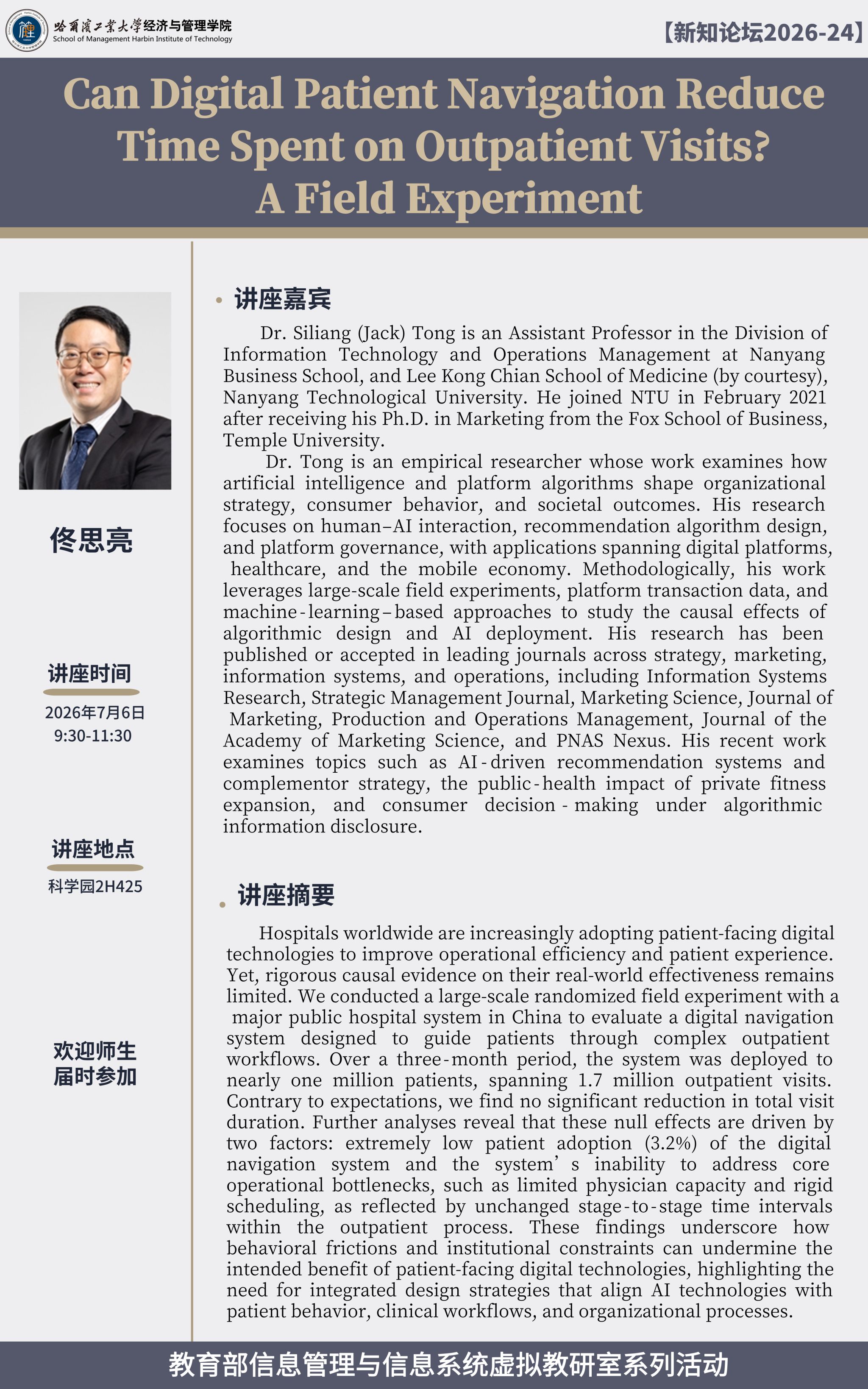
讲座时间:2026年7月6日9:30-11:30
讲座地点:科学园2H栋425室
讲座主题:Can Digital Patient Navigation Reduce Time Spent on Outpatient Visits? A Field Experiment
讲座嘉宾简介
Dr. Siliang (Jack) Tong is an Assistant Professor in the Division of Information Technology and Operations Management at Nanyang Business School, and Lee Kong Chian School of Medicine (by courtesy), Nanyang Technological University. He joined NTU in February 2021 after receiving his Ph.D. in Marketing from the Fox School of Business, Temple University.
Dr. Tong is an empirical researcher whose work examines how artificial intelligence and platform algorithms shape organizational strategy, consumer behavior, and societal outcomes. His research focuses on human–AI interaction, recommendation algorithm design, and platform governance, with applications spanning digital platforms, healthcare, and the mobile economy. Methodologically, his work leverages large-scale field experiments, platform transaction data, and machine-learning–based approaches to study the causal effects of algorithmic design and AI deployment. His research has been published or accepted in leading journals across strategy, marketing, information systems, and operations, including Information Systems Research, Strategic Management Journal, Marketing Science, Journal of Marketing, Production and Operations Management, Journal of the Academy of Marketing Science, and PNAS Nexus. His recent work examines topics such as AI-driven recommendation systems and complementor strategy, the public-health impact of private fitness expansion, and consumer decision-making under algorithmic information disclosure.
讲座摘要
Hospitals worldwide are increasingly adopting patient-facing digital technologies to improve operational efficiency and patient experience. Yet, rigorous causal evidence on their real-world effectiveness remains limited. We conducted a large-scale randomized field experiment with a major public hospital system in China to evaluate a digital navigation system designed to guide patients through complex outpatient workflows. Over a three-month period, the system was deployed to nearly one million patients, spanning 1.7 million outpatient visits. Contrary to expectations, we find no significant reduction in total visit duration. Further analyses reveal that these null effects are driven by two factors: extremely low patient adoption (3.2%) of the digital navigation system and the system’s inability to address core operational bottlenecks, such as limited physician capacity and rigid scheduling, as reflected by unchanged stage-to-stage time intervals within the outpatient process. These findings underscore how behavioral frictions and institutional constraints can undermine the intended benefit of patient-facing digital technologies, highlighting the need for integrated design strategies that align AI technologies with patient behavior, clinical workflows, and organizational processes.